
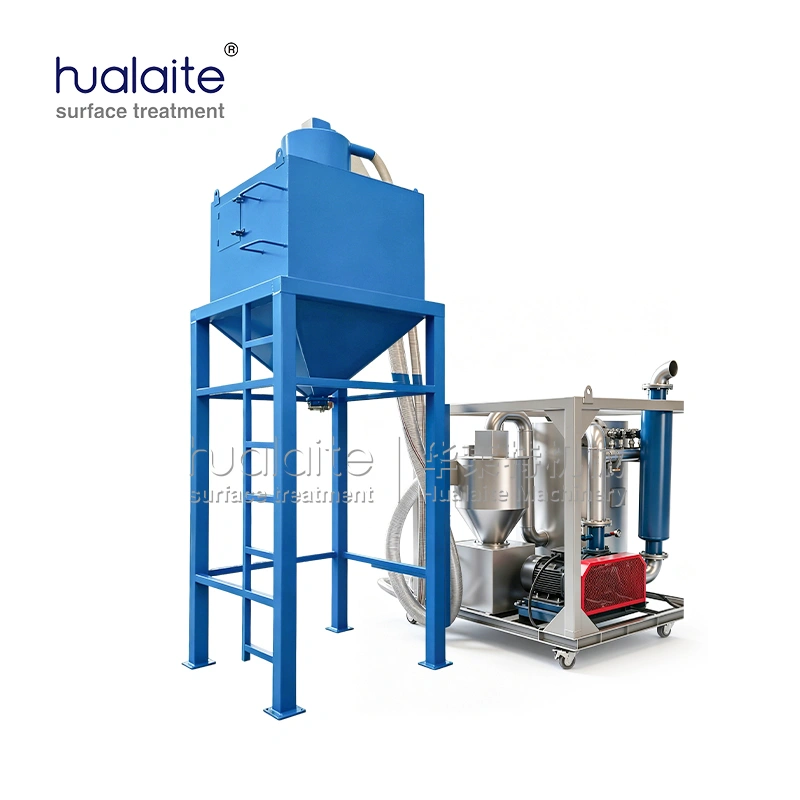
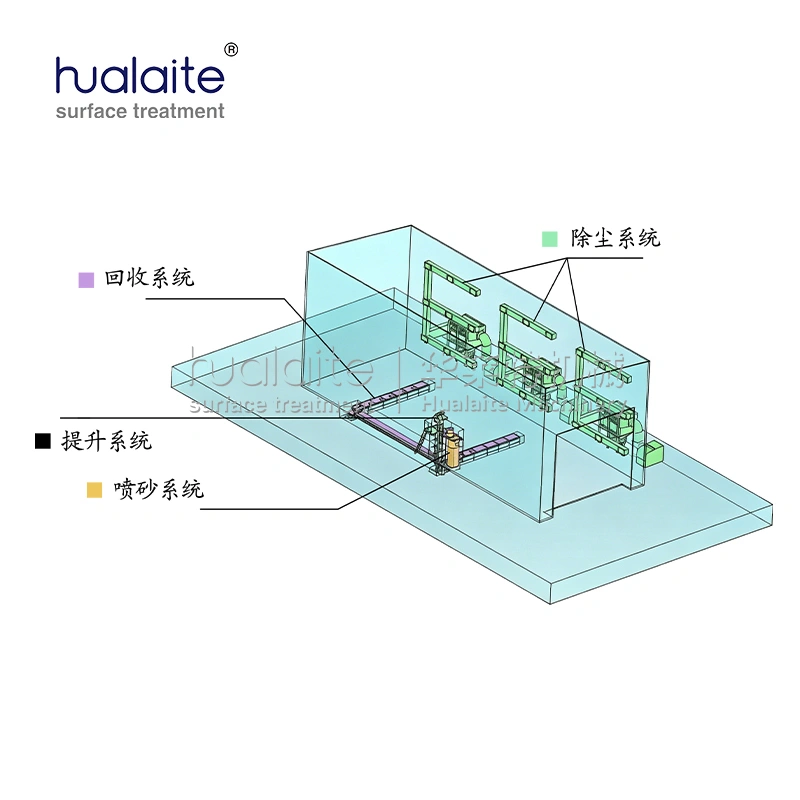
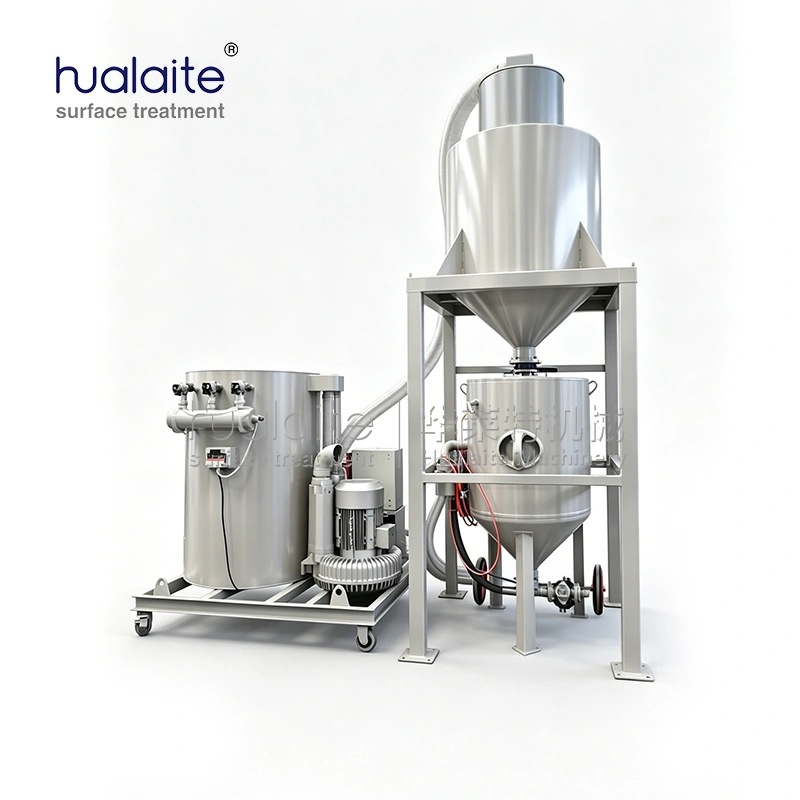
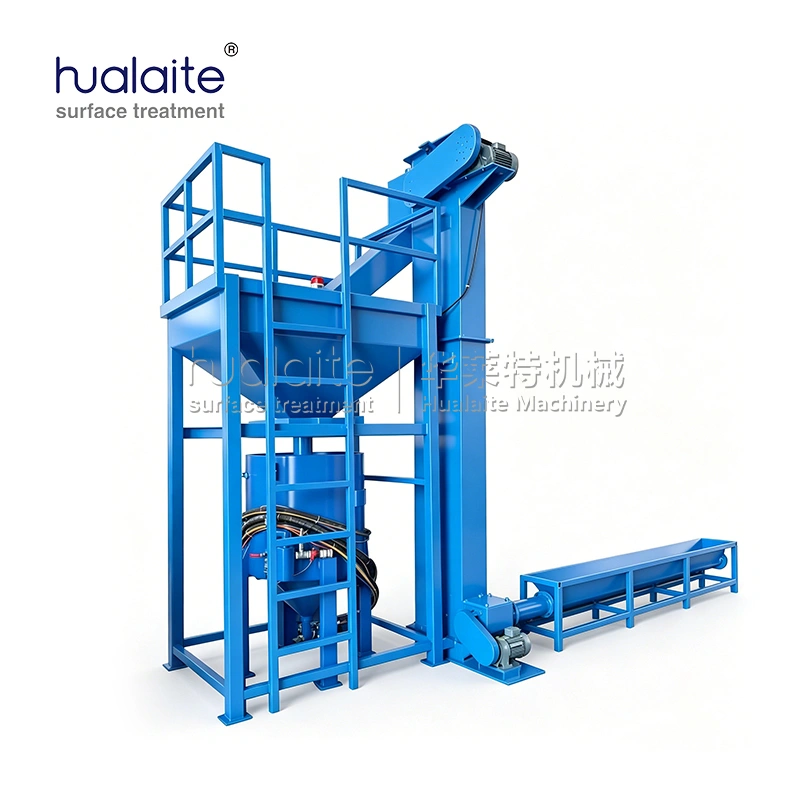
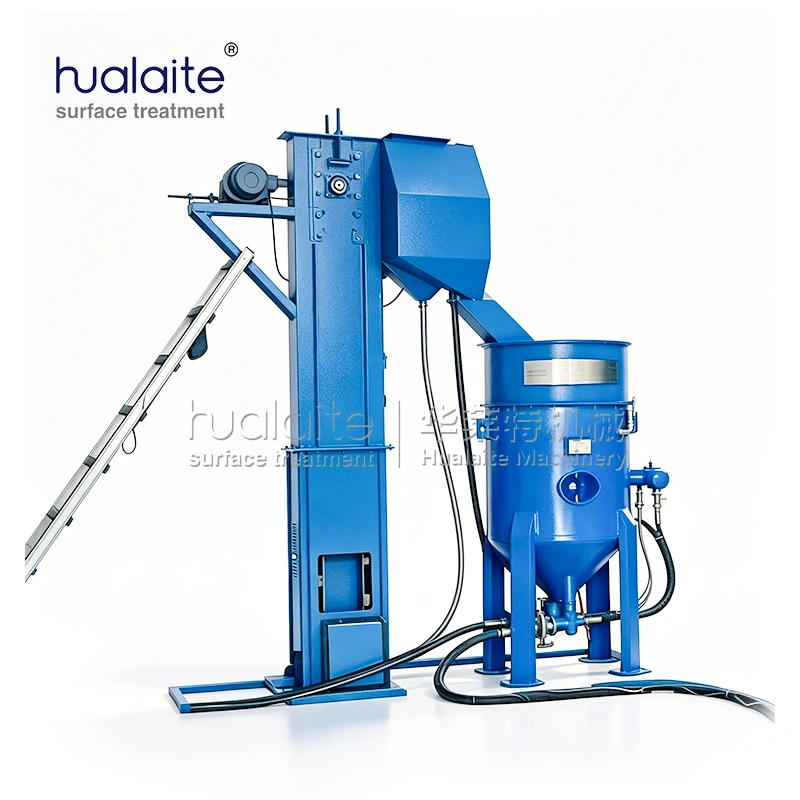
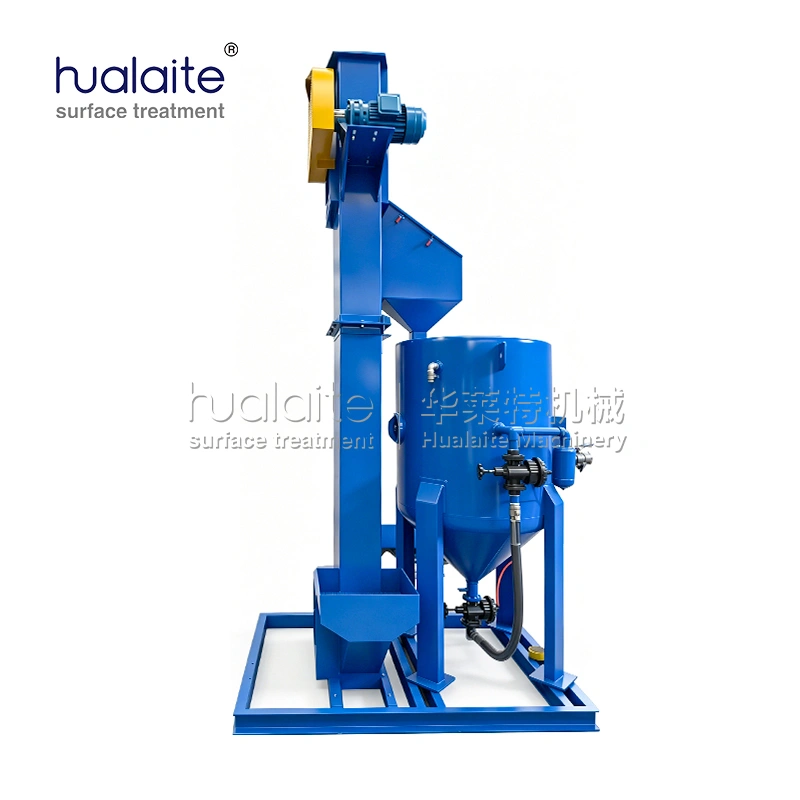
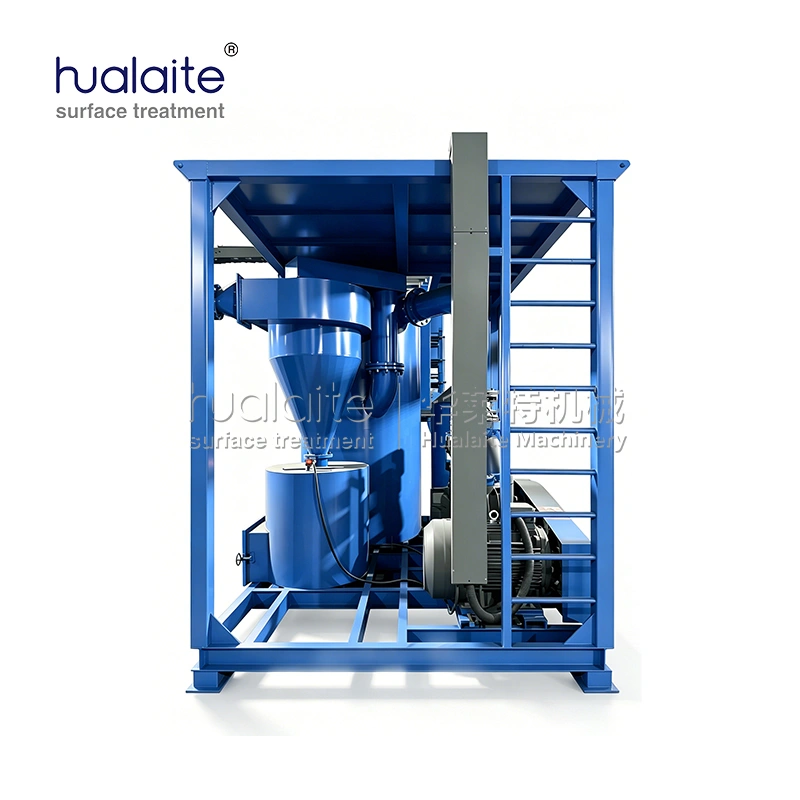
This semi-automatic partial recovery system sandblasting room is a large-scale surface treatment equipment that utilizes waffle-style suction floor or mechanical scraper recovery methods, specifically designed for blasting and cleaning of heavy workpieces such as steel structures, shipbuilding components, large castings, and welded parts. It is suitable for small-to-medium enterprises with moderate automation requirements and limited budgets, as well as on-site operations for large workpieces. The core working principle is: under the negative pressure generated by the fan, an airflow layer is formed inside the blast room from the top to the bottom; the abrasive forms a solid-gas mixture under compressed air action and is propelled onto the workpiece surface for cutting and cleaning; part of the abrasive breaks down into dust after cutting, and the downward airflow carries the dust, mixed with abrasive and rust removal impurities, through the waffle recovery floor back to the separation system for sorting; after sorting, reusable abrasive returns to the storage hopper and is automatically fed back into the blasting system for recycling; non-reusable dust and impurities are directed to the dust collector for fine filtration. Unlike fully automatic recovery systems, this semi-automatic sandblasting room adopts a partial recovery method—abrasive is mainly automatically recovered through the waffle floor or scraper recovery area, while small amounts of residual abrasive in other areas can be manually collected using brooms, shovels, or by blowing with compressed air into the recovery pit, significantly reducing equipment costs while maintaining reasonable recovery efficiency.
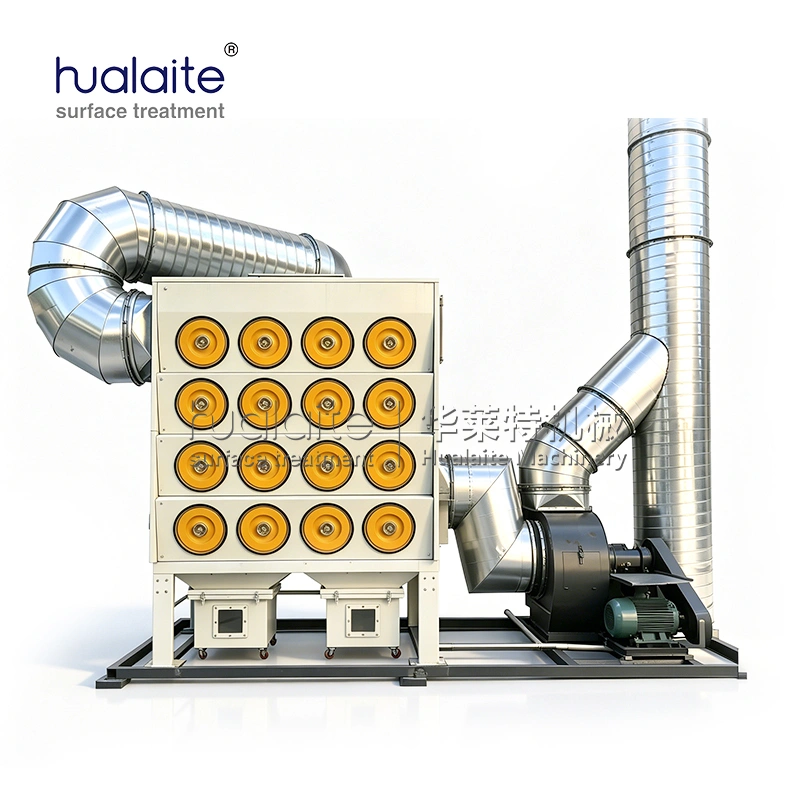
In terms of manufacturing quality and structural integrity, the blast room features a structural steel frame construction with color steel sandwich panel cladding, and the interior walls are lined with 5mm polyurethane sheets, offering durability, sound insulation, aesthetics, robustness, and excellent sealing. The recovery system offers two options: Waffle pneumatic recovery – uses pneumatic recovery principles with a waffle suction floor, eliminating the need for screw conveyors, belt conveyors, and bucket elevators, avoiding wear and blockage issues during abrasive transportation and significantly reducing failure rates and maintenance workload; Mechanical scraper recovery – uses a combination of local scrapers and bucket elevators, with a pit excavated on one side of the room for the elevator system; abrasive not falling into the pit during operation can be pushed into the recovery opening with brooms or shovels. The blasting system features one or multiple blasting pots with multiple high-speed blast guns, each individually controllable, with infinitely adjustable working pressure. The nozzles are made of durable carbide material with an average service life of 800-1000 hours. The dust collection system employs advanced cartridge filter technology with a filtration efficiency of up to 99.9%, with dust emissions far below national environmental requirements. The control system features PLC + touch screen display, supporting both automatic and manual operation modes.
The performance advantages and application value of this semi-automatic partial recovery system sandblasting room are exceptionally prominent. First, low investment cost and economical – no deep pit required (or pitless option available), low civil construction cost and short construction cycle; simple materials significantly reduce the overall cost of the sandblasting room, making it particularly suitable for small and medium enterprises. Second, flexible recovery methods – choose between waffle pneumatic recovery or mechanical scraper recovery; pneumatic recovery requires no mechanical transmission equipment with low failure rates; mechanical recovery has a simpler structure and lower cost. Third, energy-efficient operation – abrasive circulation, separation, and dust collection share a single fan (one air source for multiple purposes), saving approximately 30% energy compared to traditional sandblasting rooms. Fourth, high abrasive utilization – equipped with abrasive separation and sorting devices for automatic abrasive recycling, improving utilization rate and blasting efficiency. Fifth, wide application scope – suitable for surface rust removal of large steel structures, shipbuilding components, bridges, aerospace components, rail equipment, wind power towers, port machinery, petroleum machinery, engineering machinery, and more.
In terms of application scope, this semi-automatic sandblasting room is widely used in shipbuilding (hull plate rust removal and cleaning), steel structure engineering (surface pretreatment of bridges and building steel structures), heavy machinery manufacturing (scale removal from large castings and forgings), petrochemical industry (internal and external rust removal of storage tanks and pipelines), rail transit (rolling stock blasting cleaning), and wind power equipment (tower surface treatment). This semi-automatic partial recovery system sandblasting room is an economical surface treatment solution that balances performance and cost for small-to-medium enterprises and large workpiece on-site operations.
| 1. Housing System | |
|---|---|
| Working Size of Sandblasting Room (L×W×H) | 4×3×3 m to 20×8×6 m (Customizable on demand) |
| Gate Size (W×H) | 2.5×2.8 m to 5×5 m (Customized according to workpiece size) |
| Housing Structure | Section steel frame + square tube internal support |
| Housing Enclosure | Color steel sandwich panel with 5mm polyurethane lining on inner wall |
| Housing Features | Durable, sound-absorbing, beautiful, sturdy and airtight |
| Lighting System | Explosion-proof lamps with high indoor visibility and soft bright light |
| 2. Local Recovery System | |
| Recovery Mode | Honeycomb pneumatic recovery / Mechanical scraper recovery (Optional) |
| Honeycomb Pneumatic Recovery | Gas recovery method with moderate recovery capacity |
| Air Flow of Pneumatic Recovery | 6 m³/min |
| Air Pressure of Pneumatic Recovery | 6 kg/cm² |
| Mechanical Scraper Recovery | Local scraper + bucket elevator |
| Pit Depth | 0.8-1.5m (Square pit or pit-free design available) |
| Manual Auxiliary Recovery | Broom / Shovel / Compressed air blowing into recovery inlet |
| 3. Sandblasting System | |
| Sandblasting Mode | Pressure-feed continuous blasting |
| Sand Tank Volume | 0.3~2 m³ |
| Quantity of Spray Guns | 1~8 pcs (Independently controllable, configurable as required) |
| Nozzle Material | Durable carbide blasting nozzle |
| Nozzle Service Life | 800-1000 hours |
| Nozzle Diameter | φ6~φ16 mm |
| Blasting Pressure | 0.1~0.8 MPa (Stepless adjustable) |
| Single Gun Cleaning Rate | 10~30 m²/h |
| Applicable Abrasives | Steel shot, glass bead, steel grit, quartz sand, copper slag, yellow sand, fruit shell, etc. |
| 4. Dust Removal System | |
| Dust Removal Type | Filter cartridge dust collector |
| Filtration Efficiency | ≥99.9% |
| Filtration Precision | 0.3μm |
| Dust Emission Concentration | ≤20 mg/m³ |
| Filter Cartridge Features | Imported long fiber filter media with twice filtration area of standard cartridges |
| 5. Abrasive & Dust Separation System | |
| Separator Type | Cyclone Separator / Aerodynamic Classifier |
| Separation Performance | Effective separation of abrasives, impurities and dust |
| Circulation Method | Recycled abrasives automatically return to storage bin |
| Waste Disposal | Dust and impurities enter dust collector for fine filtration |
| 6. Electrical Control System | |
| Control Mode | PLC intelligent control + touch screen |
| Control Functions | Automatic control of abrasive recovery, sorting, spray gun operation, dust cleaning and sand tank blasting |
| Operation Modes | Automatic mode / Manual mode |
| Fault Alarm | Automatic alarm for system malfunctions |
| 7. Workpiece Conveying System (Optional) | |
| Conveying Mode | Rail flat trolley / Handcart / Electric flat car |
| Max Workpiece Dimension | Customized based on housing size |
| Max Workpiece Weight | 5~30 tons (Customizable) |
| 8. Application Parameters | |
| Applicable Workpieces | Steel structures, ship parts, large castings, forgings, weldments, steel pipes, towers, etc. |
| Applicable Industries | Shipbuilding & repair, steel structure engineering, heavy machinery, petrochemical, rail transit, wind power equipment |
| Surface Preparation Grade | Sa2.5~Sa3 (GB8923-88 / ISO8501-1) |
| Multi-purpose Fan Design | One fan for abrasive circulation separation and dust removal, saving about 30% energy consumption |
| 9. Equipment Composition | |
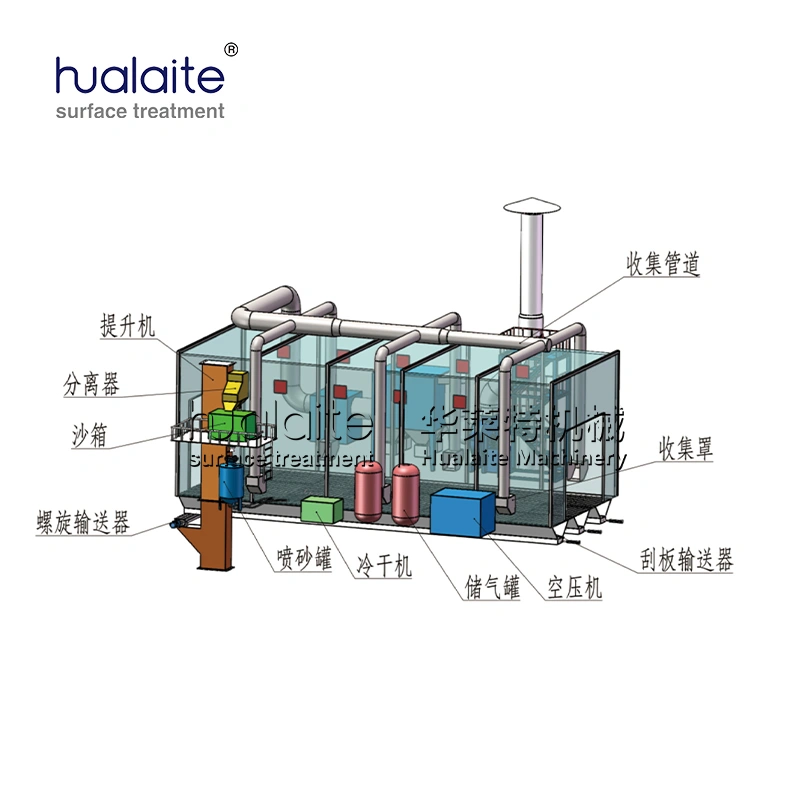
| This unit consists of sandblasting housing (section steel frame, color steel sandwich panel enclosure, 5mm polyurethane lining & lighting system), local recovery system (honeycomb pneumatic recovery floor or mechanical scraper + bucket elevator), abrasive dust separation system (cyclone separator / aerodynamic classifier), sandblasting system (continuous pressurized sand tank, spray guns & control system), dust removal system (filter cartridge dust collector & exhaust pipelines), electrical control system (PLC, touch screen & fault alarm), and optional workpiece conveying system (rail trolley / handcart). | |
| 10. Customization Description | |
| This equipment is large non-standard customized equipment. Custom design is available according to customer’s workpiece size, processing capacity, site conditions and budget. Main customizable modules are listed below: | |
| Housing Size | L 4~20m × W 3~8m × H 3~6m (Customized by maximum workpiece dimension) |
| Recovery System | Honeycomb pneumatic recovery / Mechanical scraper recovery (Select based on budget and site) |
| Sandblasting System | Sand tank volume (0.3~2m³), spray gun quantity (1~8 pcs), nozzle specifications |
| Dust Removal System | Filter cartridge quantity & specification, air handling capacity |
| Workpiece Conveying | Rail trolley / Handcart / No conveyor (Fixed workpiece) |
| Pit Option | Pit type / Pit-free type (Select based on site condition) |
| Control System | Standard PLC control / PLC + touch screen full computer control |
Reviews
There are no reviews yet.