
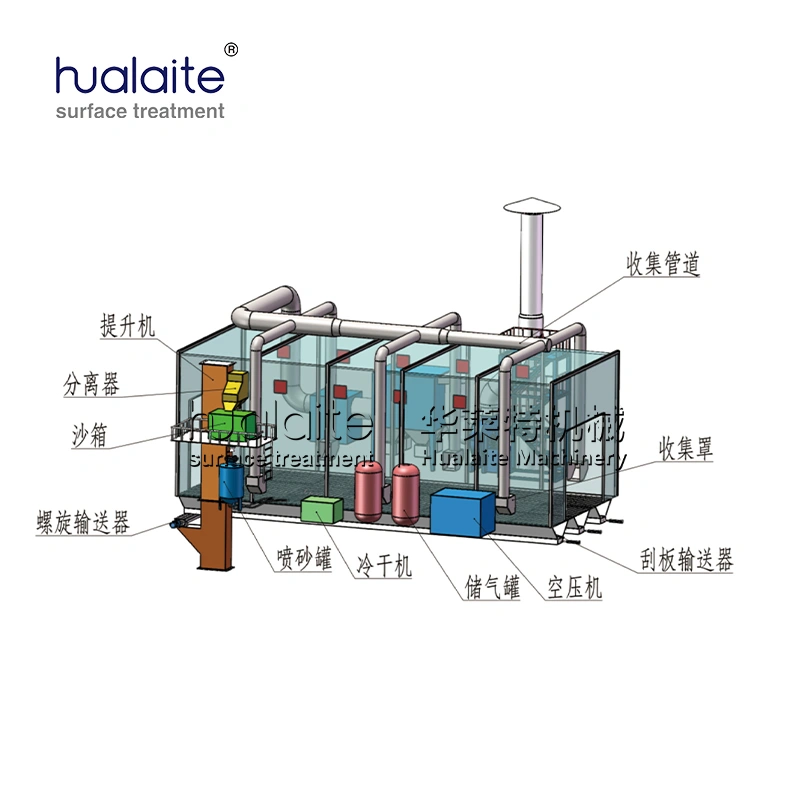
This fully automatic abrasive recovery blast room is a large-scale, intelligent surface treatment system that combines a honeycomb-style abrasive recovery floor with pneumatic conveying technology. It is specifically designed for the abrasive blasting and cleaning of heavy workpieces, such as steel structures, ships, large castings, and welded components. Its core operating principle involves using the honeycomb floor technology and pneumatic conveying to recover abrasive media via the airflow generated by a negative-pressure fan; the media is transported through piping to an abrasive-dust separator, where usable abrasive automatically falls into the pressure blast tank for the next blasting cycle, while waste materials—such as broken abrasive, welding slag, mill scale, and dust—are automatically routed to the dust collection system for filtration. The entire system achieves fully automated control over the complete process—including abrasive recovery and sorting, blast gun operation, dust collection, and blast tank functioning—and features automatic fault alarms, thereby significantly reducing the need for manual intervention.
Regarding manufacturing and structural quality, the blast room enclosure utilizes a structural steel frame design, with exterior walls constructed from 50mm-thick color-coated steel sandwich panels (featuring a steel sheet thickness of 0.36mm). …panels feature a sound-insulating polystyrene core to effectively reduce noise. The structure utilizes square tubing for internal support, offering an aesthetically pleasing appearance, ease of installation, and corrosion-resistant durability, while also providing excellent sound insulation and thermal properties. The honeycomb flooring is a core technical component of the system; constructed from steel mesh with symmetrically arranged “V”-shaped grilles, it facilitates both the collection and removal of abrasive media and ensures safe footing for workers. Unlike traditional mechanical recovery blast rooms—which require deep excavation and the installation of extensive mechanical equipment such as screw conveyors and bucket elevators—this fully automatic recovery blast room employs pneumatic conveying principles. It eliminates the need for mechanical conveyors and deep pits, thereby significantly reducing civil engineering costs and construction time. Key wear-prone areas are fitted with standardized modular components to facilitate maintenance and replacement. The dust collection system utilizes a high-efficiency cartridge dust collector (featuring 16–96 cartridges and a filtration area of 160–960 m²). Employing an optimized dust extraction method, it rapidly draws dust generated during blasting operations into the extraction ductwork and through a high-efficiency… …filtration is handled by a dust collector. The entire unit utilizes an intelligent PLC control system paired with a touchscreen interface, enabling both automatic and manual operation modes; interlocked system controls significantly enhance the ease of inspection and maintenance.
This fully automatic recovery system for blast rooms offers outstanding performance advantages and application value. First, it boasts extremely high abrasive recovery efficiency: utilizing pneumatic piping for transport, the recovery rate reaches 99%—far surpassing traditional mechanical recovery methods. The integrated suction floor recovers all abrasive material instantly, leaving no residue on the ground and eliminating the need for manual cleanup. Second, it requires no deep excavation, resulting in low civil engineering costs: the honeycomb floor structure eliminates the need for deep pits, requiring a depth of only 0.8 to 1 meter (or no pit at all in some locations), which significantly saves on infrastructure investment and shortens construction time. Third, it offers low operating costs and is energy-efficient and eco-friendly: the absence of mechanical drive components results in low failure rates and maintenance-free operation, reducing downtime and associated losses; the airflow balance design of the honeycomb floor recovery system cuts fan energy consumption by approximately 15%–25%; and dust emissions meet or fall below national and local standards. …environmental requirements. Fourth, it offers an excellent working environment: the blast chamber utilizes a dust-suppression circulation system featuring top-down airflow—with air intake at the top and extraction at both the bottom and sides—ensuring dust is continuously drawn downwards; this maintains high visibility and a favorable operating environment for staff, with illumination levels exceeding 400 lux. Fifth, it has a wide range of applications, making it suitable for the abrasive blasting of large workpieces such as steel structures, ships (during construction and repair), steel plates, boilers, shipping containers, transformer housings, and large castings.
Regarding its scope of application, this blast room with an automatic recovery system is widely used in sectors such as shipbuilding and repair (rust removal and cleaning of hull plates and compartments), steel structure engineering (surface pretreatment for bridges and architectural steel), heavy machinery manufacturing (scale removal and surface strengthening for large castings, forgings, and welded parts), the petrochemical industry (rust removal on the inner and outer walls of storage tanks and pipelines), rail transportation (blast cleaning of rolling stock and carriages), wind power equipment (surface treatment for tower sections and blade molds), and military equipment manufacturing. This blast room with an automatic recovery system is an indispensable core piece of equipment for the surface treatment of large, modern workpieces.
| 1. Housing System | |
|---|---|
| Working Size of Sandblasting Room (L×W×H) | 4×3×3 m to 30×10×8 m (Customizable on demand) |
| Gate Size (W×H) | 2.8×3.2 m to 6×6 m (Customized according to workpiece size) |
| Housing Structure | Section steel frame + square tube internal support |
| Housing Enclosure | 50mm thick color steel sandwich panel (δ=0.36mm), filled with sound-insulated polystyrene |
| Housing Features | Anti-corrosion & durable, heat preservation & insulation, noise reduction, relocatable reconstruction |
| Lighting System | Philips explosion-proof halogen lamp / LED explosion-proof lamp, illuminance ≥400LUX |
| Indoor Visibility | ≥5m |
| 2. Honeycomb Floor Recovery System | |
| Recovery Method | Pneumatic conveying type (honeycomb sand suction floor) |
| Floor Structure | Metal steel mesh, symmetrically distributed V-shaped grilles |
| Pit Depth | 0.8-1.0m (No pit required for some sites) |
| Recovery Power | Fan negative pressure pneumatic conveying |
| Abrasive Recovery Rate | ≥99% |
| Recovery Capacity | 5~10 tons/hour |
| Recovery Area | Approx. 70 m² (Standard configuration) |
| 3. Sandblasting System | |
| Sandblasting Mode | Pressure-feed type (continuous pressurization) |
| Sandblasting Tank Diameter | φ600~2000 mm |
| Sandblasting Tank Volume | 0.5~3 m³ |
| Number of Spray Guns | 2~12 pcs (Configurable on demand) |
| Nozzle Diameter | φ6~φ16 mm |
| Sandblasting Pressure | 0.1~0.8 MPa (Stepless adjustable) |
| Abrasive Flow Rate | 0~2200 kg/h (Freely adjustable) |
| Single Gun Cleaning Speed | 15~30 m²/h |
| Air Consumption Per Gun | 8~10 m³/min |
| Sandblasting Control Mode | Remote control / Manual control |
| 4. Dust Removal System | |
| Dust Removal Mode | Pulse back-blow automatic cleaning filter cartridge dust collector |
| Number of Filter Cartridges | 16~96 pcs |
| Filtration Area | 160~960 m² |
| Air Handling Capacity | 5,000~100,000 m³/h |
| Dust Removal Efficiency | ≥99.9% |
| Dust Emission Concentration | ≤10~20 mg/m³ |
| Filtration Precision | 0.3μm |
| Fan Power | 7.5~110 kW |
| Ventilation Frequency | ≥50 times/hour |
| 5. Abrasive Dust Separation System | |
| Separator Type | Cyclone separator / Venturi abrasive dust separator |
| Separation Efficiency | High-efficiency separation of steel shot, slag and dust |
| Sorting Precision | Remove broken shot less than 0.1mm |
| Applicable Abrasives | Steel shot, steel grit, brown corundum, white corundum, glass beads, etc. |
| Initial Abrasive Filling Quantity | 1000~5000 kg (Depends on housing size) |
| 6. Electrical Control System | |
| Control Mode | PLC intelligent control + touch screen display |
| Control Functions | Automatic abrasive recovery control, automatic abrasive dust sorting control, automatic spray gun control, automatic dust cleaning control, automatic sand tank operation control, automatic system fault alarm |
| Operation Modes | Automatic operation mode / Manual control mode |
| Main Components | Imported or well-known domestic brand products |
| Control Cabinet | Circuit layout in accordance with national standards, equipped with control schematic diagram (GB/T-6988.1-2001) |
| 7. Workpiece Conveying System (Optional) | |
| Conveying Mode | Rail flat car / Trolley / Overhead conveyor |
| Max Workpiece Size | Customized according to housing dimension |
| Max Workpiece Weight | 5~50 tons (Customizable) |
| 8. Applicable Parameters | |
| Applicable Workpieces | Steel structures, ship components, large castings, forgings, welded parts, heat-treated parts, containers, transformer shells, special-shaped parts, etc. |
| Applicable Industries | Ship repair & construction, steel structure engineering, heavy machinery, petrochemical industry, rail transit, wind power equipment, military equipment |
| Surface Cleaning Grade | Sa2.5~Sa3 (GB8923-88 / ISO8501-1) |
| Surface Roughness | 40~75μm (Depends on abrasive particle size) |
| Sandblasting Mode | Fixed workpiece with manual blasting / Automatic robot blasting |
| 9. Equipment Composition | |
| Composed of sandblasting housing (section steel frame + color steel sandwich enclosure + lighting system), honeycomb sand suction floor (metal steel mesh + V-shaped grille), pneumatic recovery system (high-pressure fan + sand suction pipeline), abrasive dust separation system (cyclone separator / Venturi separator), sandblasting system (continuous pressurized sand tank + spray guns + control system), dust removal system (pulse back-blow filter cartridge dust collector + dust extraction pipeline), electrical control system (PLC + touch screen + interlock control) and workpiece conveying system (rail flat car / trolley / overhead conveyor, optional). | |
| 10. Customization Instructions | |
| This equipment is a large non-standard customized product, which can be fully customized according to customer workpiece size, processing capacity, site conditions and process requirements. Main customizable modules are as follows: | |
| Housing Size | Length 4~30m × Width 3~10m × Height 3~8m (Customized by maximum workpiece dimension) |
| Gate Size | Customized according to workpiece access requirements |
| Recovery Mode | Pneumatic recovery (honeycomb floor) / Mechanical recovery (screw + bucket elevator) |
| Sandblasting System | Sand tank volume (0.5~3m³), number of spray guns (2~12 pcs), nozzle specifications |
| Dust Removal System | Number of filter cartridges (16~96 pcs), air handling capacity (5,000~100,000m³/h) |
| Workpiece Conveying | Rail flat car / Trolley / Overhead conveyor / No conveying (Fixed workpiece) |
| Sandblasting Mode | Manual blasting / Automatic robot blasting |
| Control System | Standard PLC control / PLC + touch screen full computer control / Remote monitoring system |
| Pit Requirement | With pit / Pit-free (Select according to site conditions) |
Reviews
There are no reviews yet.