
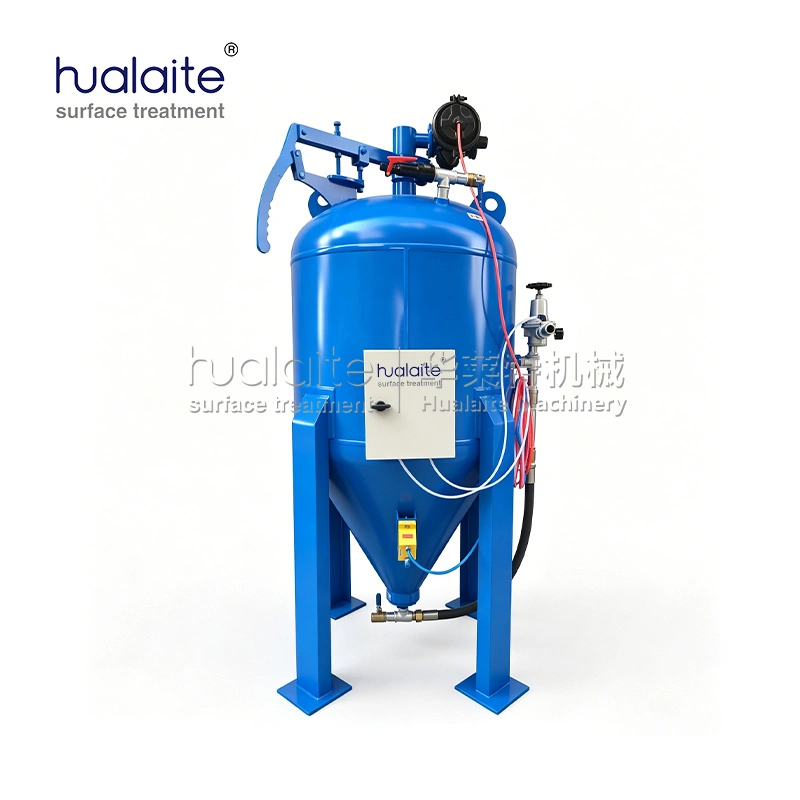
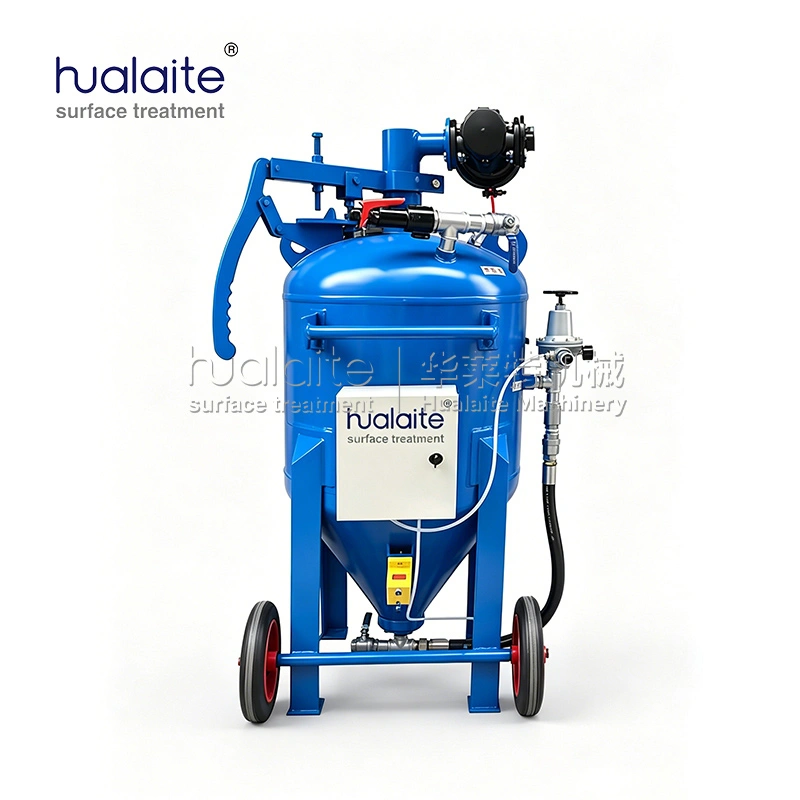
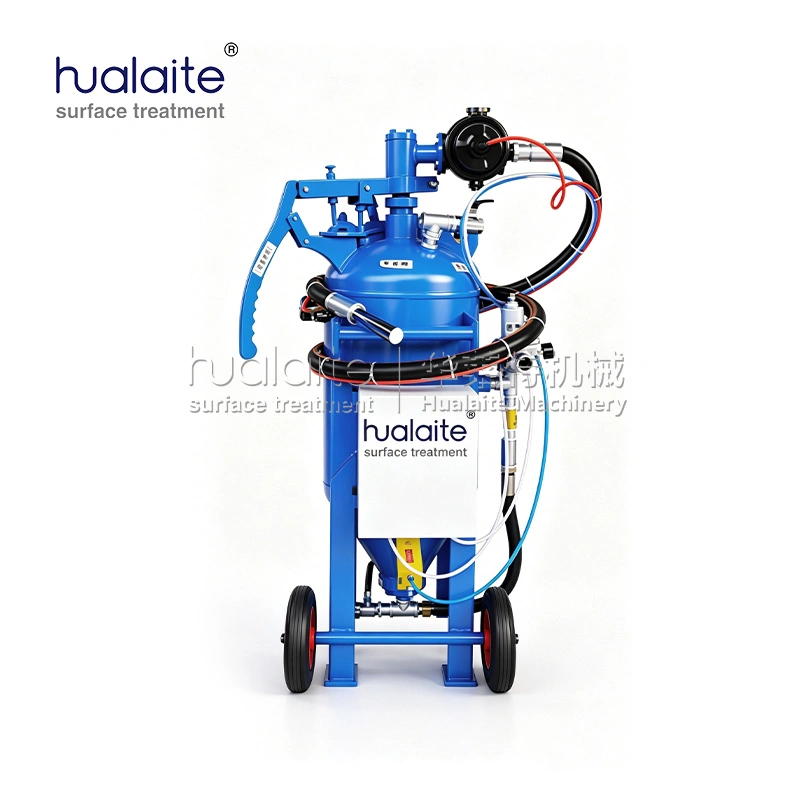
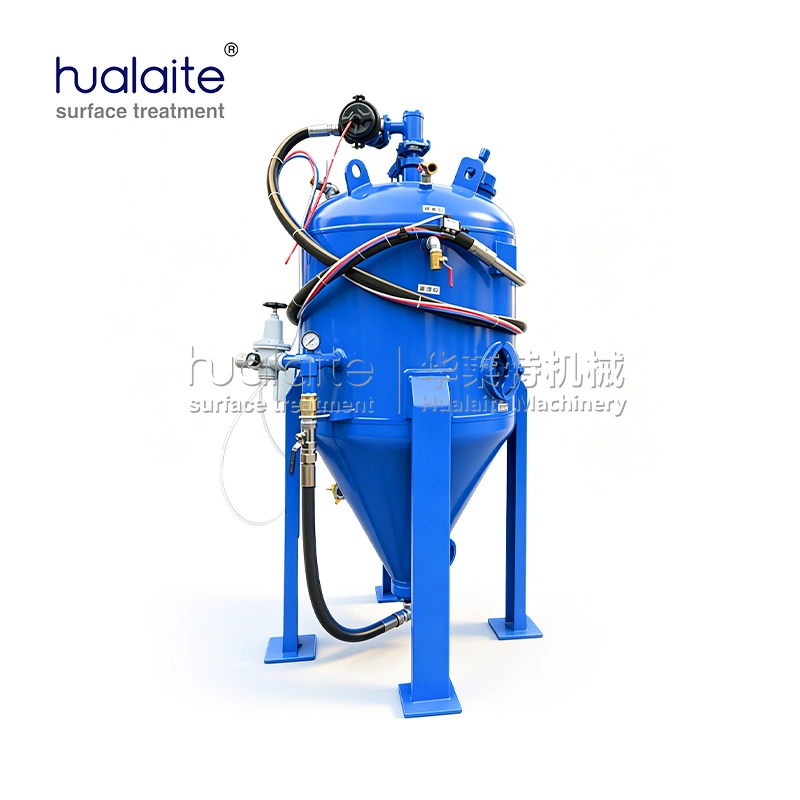
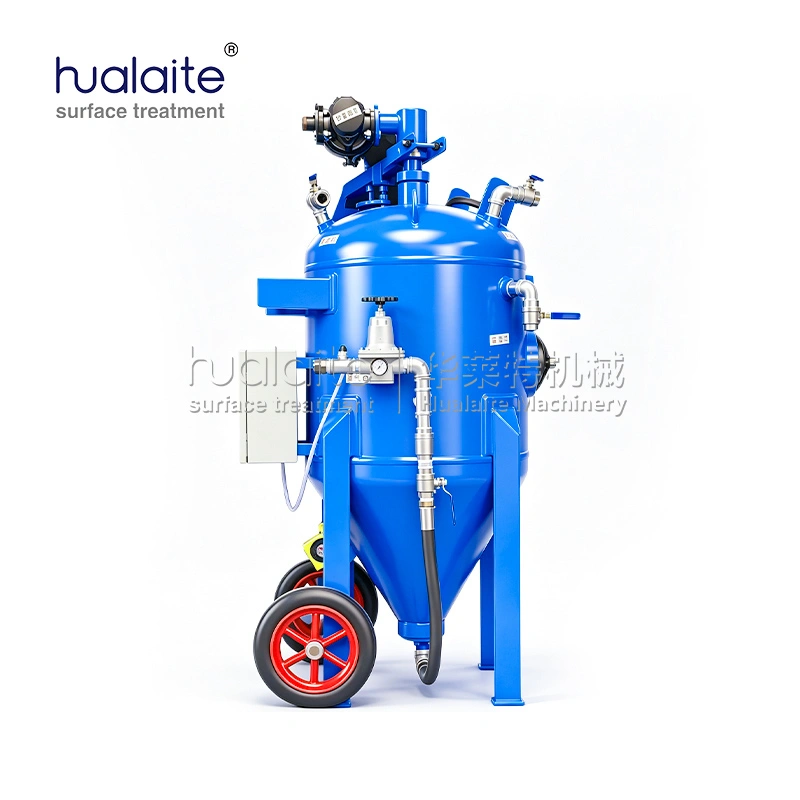
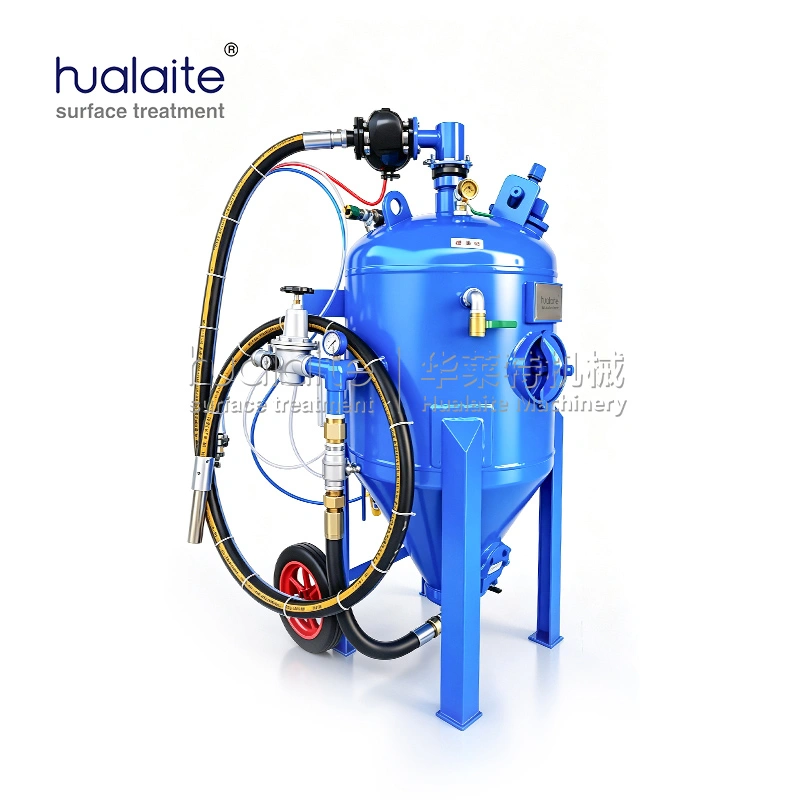
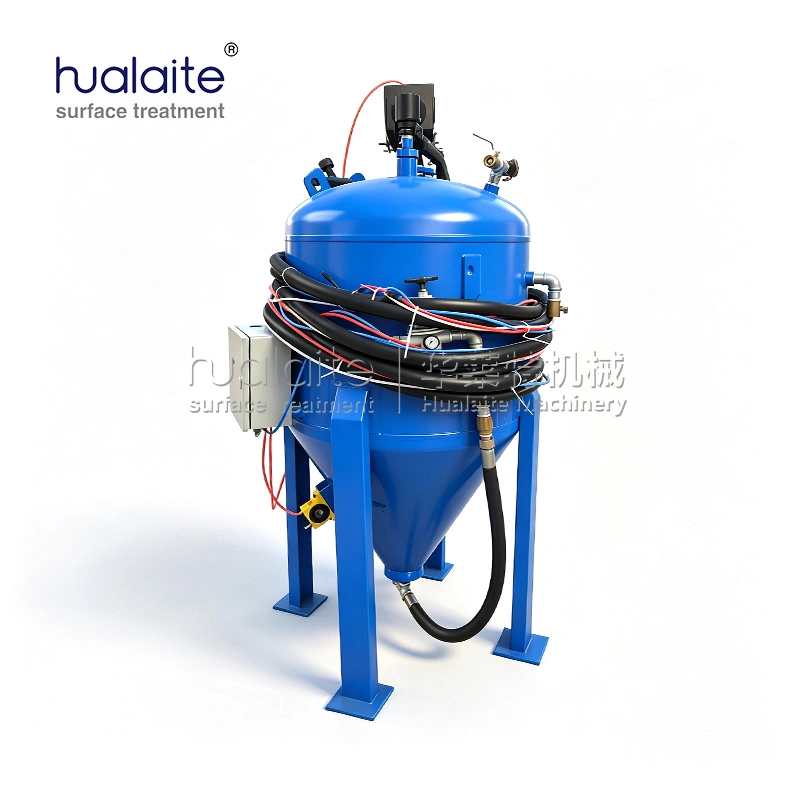
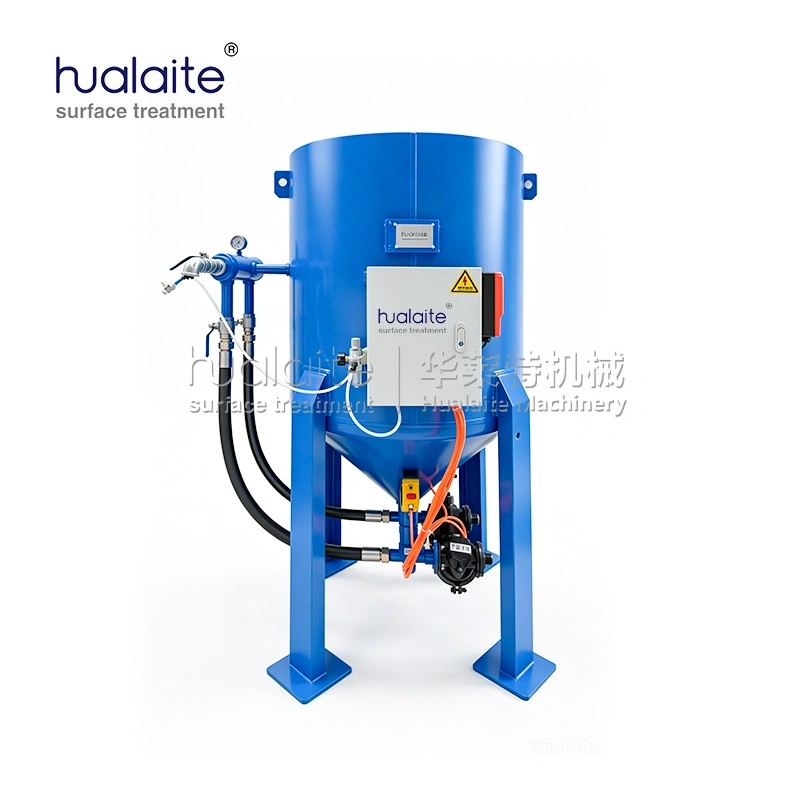
This water‑sand mixing sandblasting machine is a wet‑type blasting system powered by compressed air, using a slurry of abrasive media and water as the blasting medium to process workpiece surfaces. The working principle is as follows: abrasive media (such as brown aluminium oxide, glass beads, steel grit, etc.) are mixed with water in a specific ratio to form a slurry (abrasive typically accounts for 20%–35%). Through a direct‑pressure working system driven by compressed air, the slurry is propelled through the blast gun and ejected at high velocity onto the workpiece surface. The mixture of abrasive and water impacts the surface at high speed the moment it leaves the nozzle; the abrasive’s cutting action removes scale, rust, coatings, and burrs, while the water stream simultaneously cools the workpiece and suppresses dust. This water‑sand mixing blasting pot offers two mixing methods: either the abrasive and water are pre‑mixed inside the tank before being forced out, or the abrasive and water are stored separately in the tank and mixed just before the nozzle.
In terms of manufacturing quality and structural integrity, the tank body of this water‑sand mixing sandblasting machine is rolled and welded from high‑quality carbon steel plates of no less than 5mm thickness, or corrosion‑resistant stainless steel material, with all welds undergoing rigorous inspection. The interior is meticulously anti‑corrosion treated to withstand the corrosive effects of water‑sand mixing operation. For processing steel parts, corrosion inhibitors such as sodium nitrite can be added to the water to prevent workpiece rusting. The entire unit features a wheeled mobile structure with pneumatic tyres or solid wheels, allowing easy transfer between different job sites. The blast hose is made of specially formulated wear‑resistant rubber with an inner diameter of φ25mm, supplied in standard lengths of 9 to 10 metres and extendable as needed. The blast gun is equipped with a high‑wear boron carbide nozzle (φ6~φ12mm, optional), offering long service life and high blasting efficiency. The control system employs a pneumatic remote control valve or foot pedal, making operation simple and responsive. For models equipped with automatic recovery functionality, a specially designed recovery head captures both the discharged abrasive and the dust generated during blasting, processing them so that the abrasive can be returned to the tank for reuse.
The performance advantages and application value of this water‑sand mixing sandblasting equipment are exceptionally notable. First, outstanding dust‑free environmental performance – when the water‑sand mixture is blasted, the water curtain effectively encapsulates the abrasive and settles dust, completely eliminating the dust dispersion problems inherent in traditional dry blasting. Compared to conventional dry blasters, wet blasting can reduce dust emissions by up to 92%. Second, superior processing quality – the addition of water reduces the impact force of the abrasive on the workpiece surface, minimising material removal and leaving a smoother, finer finish. Wet blasting is also more efficient than dry blasting, consumes less abrasive, and improves surface cleanliness, finish, strength, and coating adhesion. Third, easy installation and operation – no separate workshop is required; processing can be performed directly on the production line. Fourth, no chemical pollution – the system uses tap water and natural sand (shot) in a recirculating process, discharging no toxic wastewater and causing no environmental pollution. Fifth, wide application scope – this machine can remove scale and welding slag from heat‑treated parts, welded components, castings, and forgings, achieving cleaning quality up to Sa3 grade. It can also perform surface finishing and decorative treatment of parts with special requirements. To prevent rusting of steel parts, corrosion inhibitors can be added to the water; abrasive should be dried before the next use.
In terms of application scope, this water‑sand mixing sandblasting machine is widely used for: rust removal and anti‑corrosion treatment of steel structures in shipbuilding and offshore platforms; on‑site rust removal of steel bridges, oil pipelines, and hydraulic engineering projects; graffiti removal, paint stripping, and marine coating removal; surface cleaning of gas station oil tanks; scale removal and deburring of mechanical components; surface pre‑treatment before painting and plating; refurbishment of old parts; and fine finishing of precision parts with high surface quality requirements. With its outstanding advantages of dust‑free environmental protection, high efficiency, superior quality, and flexible mobility, this water‑sand mixing blasting pot has become the ideal choice in the modern surface treatment industry for applications requiring both environmental responsibility and operational efficiency.
| 1. Overall Machine Size & Weight | |
|---|---|
| Tank Diameter | φ400~φ1000mm |
| Tank Volume | 0.1~1.5m³ (100~1500L) |
| Overall Dimension (L×W×H) | 600~1200 × 600~1200 × 1400~2000mm |
| Net Machine Weight | 80~350kg |
| 2. Pressure Vessel Parameters | |
| Design Pressure | 0.8~1.0MPa |
| Adjustable Working Pressure Range | 0.2~0.8MPa |
| Safety Accessories | Safety valve, pressure gauge, stop valve, exhaust valve |
| Tank Material | 5~8mm high-quality carbon steel / corrosion-resistant stainless steel (optional) |
| Manufacturing Standard | Compliant with national pressure vessel safety supervision regulations |
| 3. Water-Abrasive Mixing System | |
| Mixing Mode | Pre-mixing inside tank / front nozzle mixing |
| Water-Abrasive Mix Ratio | Abrasive 20%~35%, Water 65%~80% |
| Max Water & Abrasive Capacity | 0.18~1.0m³ |
| Water Supply | Industrial tap water, corrosion inhibitor available for anti-rust treatment |
| Stirring Mode | Manual stirring / automatic stirring (optional) |
| 4. Blasting System | |
| Number of Spray Guns | 1~2 pcs |
| Nozzle Material | High wear-resistant boron carbide |
| Nozzle Inner Diameter | φ6~φ12mm |
| Standard Blasting Hose Length | 9~10m, extendable up to 30m |
| Blasting Hose Inner Diameter | φ25mm special wear-resistant rubber hose |
| Working Mode | Pressure feed type (direct pressure) |
| 5. Air Source Requirements | |
| Compressed Air Pressure | 0.5~0.8MPa |
| Air Consumption (Single Gun) | 2~4.5m³/min @ 0.6MPa |
| Air Consumption (Dual Guns) | 4~9m³/min |
| Air Source Connector | 1 inch female thread |
| Recommended Matching Air Compressor | 15~45kW (20~60HP) |
| 6. Working Efficiency & Surface Quality | |
| Rust Removal Efficiency (Single Gun) | 10~40m²/hour |
| Rust Removal Efficiency (Dual Guns) | 40~65m²/hour |
| Surface Cleaning Grade | Sa2.5~Sa3 |
| Surface Roughness Ra | 0.8~6.3μm |
| Dust Suppression Rate | ≥92% |
| 7. Applicable Abrasives | |
| Dry Blasting Abrasives | Brown corundum, white corundum, steel grit, steel shot, quartz sand, etc. |
| Wet Blasting Abrasives | 36~120# brown corundum, white corundum, glass beads, ceramic sand, etc. |
| Abrasive Mesh Range | 36#~280#; 36#~120# recommended for wet blasting |
| Single Sand Loading Capacity | 50~260kg |
| 8. Movement & Operation | |
| Moving Structure | Wheeled design (inflatable tire or solid rubber wheel) |
| Control Mode | Pneumatic remote control valve / foot pedal switch |
| Required Operator | 1 operator |
| Applicable Scenarios | Outdoor open-air operation, ventilated indoor space, on-site emergency maintenance |
| 9. Equipment Composition | |
| Pressure blasting tank (equipped with safety valve, pressure gauge, stop valve), water-abrasive mixing system, blasting hose with connectors, spray gun fitted with boron carbide nozzle, wheeled mobile base, air connecting pipelines. Air compressor shall be prepared by customer separately. | |
| 10. Customization Instructions | |
| Customizable non-standard items: tank volume & material (carbon steel/stainless steel), spray gun quantity (1~2), nozzle size φ6~φ12, mixing mode (in-tank pre-mixing / front nozzle mixing), automatic stirring unit, automatic abrasive recovery system and other attachments. | |
Reviews
There are no reviews yet.