
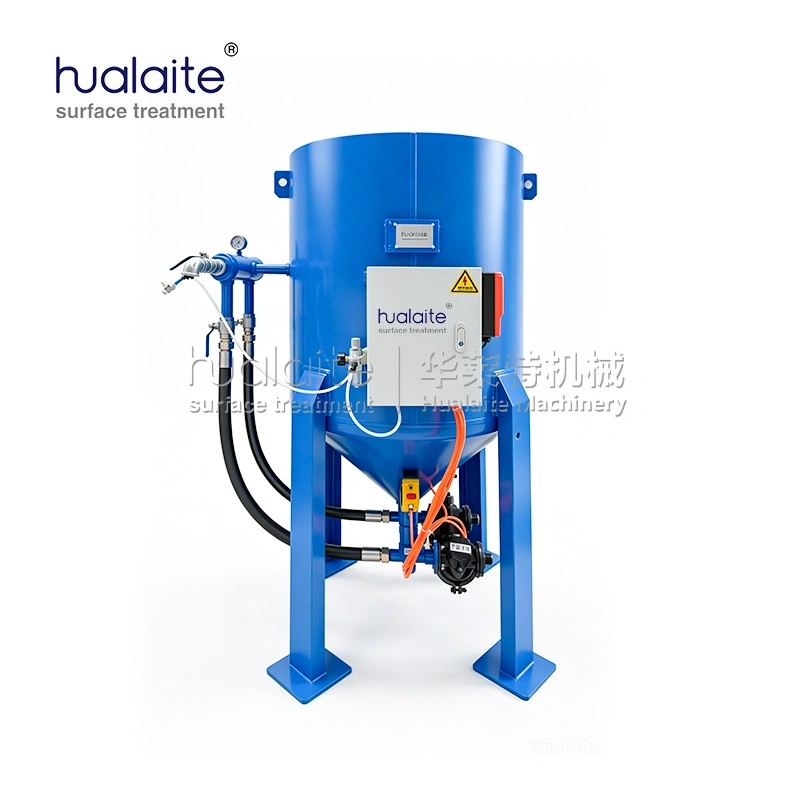
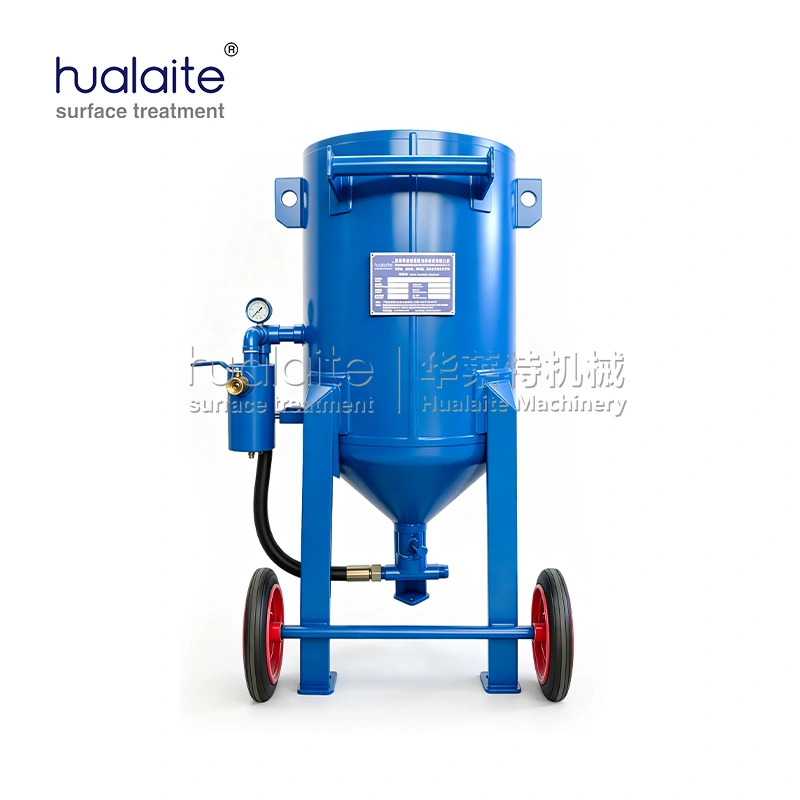
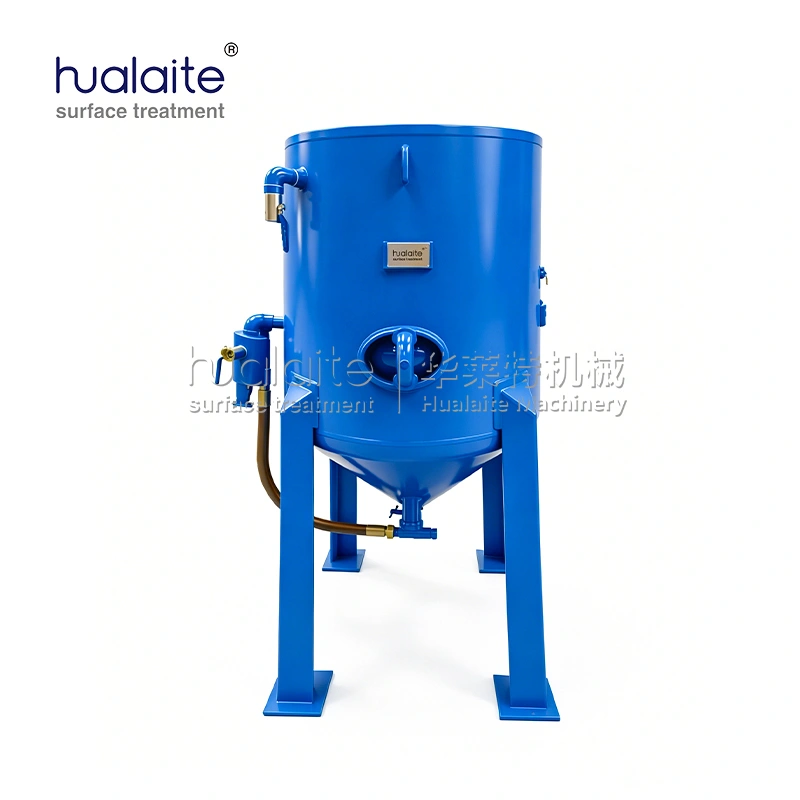
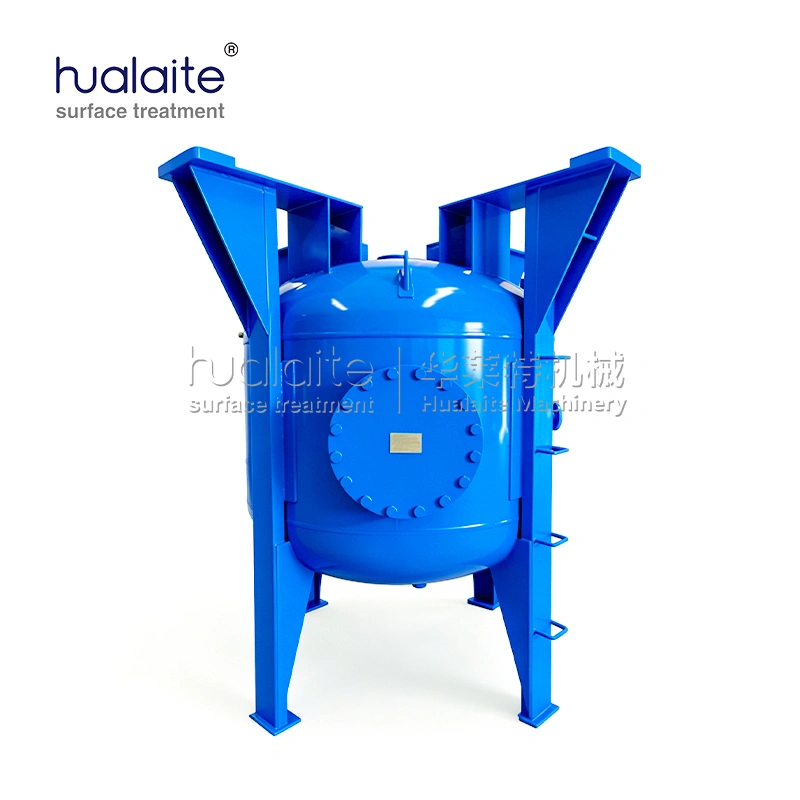
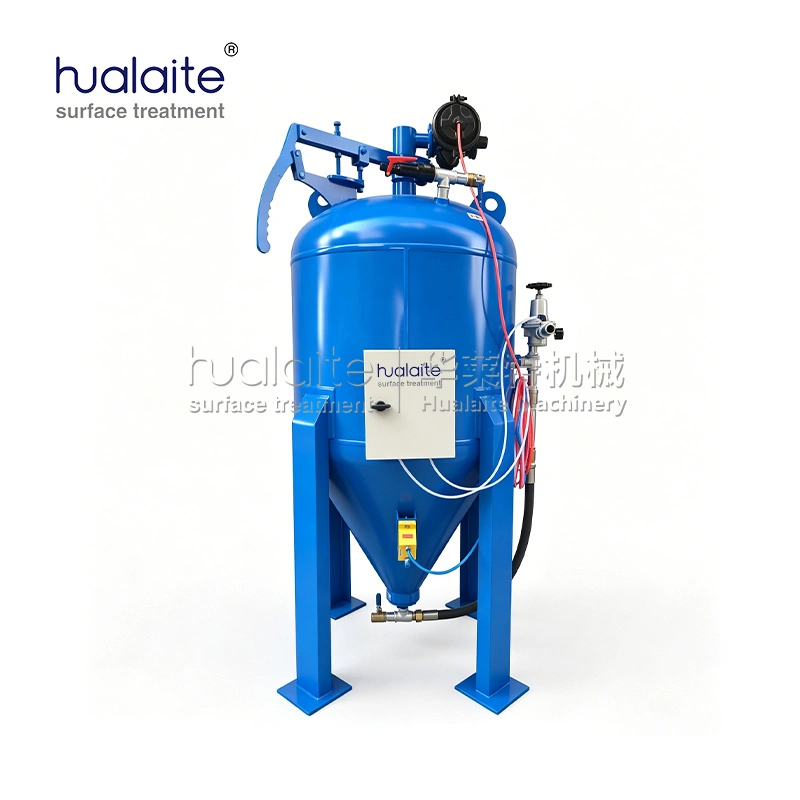
This dry‑wet sandblasting machine is an open‑type blasting system that operates on the direct‑pressure (pressure‑fed) working principle. Its core component is a sealed pressure vessel that can withstand high internal pressure. Compressed air flows at high speed inside the tank to create a high‑pressure effect, forcing the abrasive media out through the blast hose and nozzle at high velocity onto the workpiece surface, where the impact and cutting action remove rust, scale, coatings, and create the desired surface profile. Unlike the fixed‑type machines described previously, this mobile dry‑wet sandblasting pot‘s most distinctive feature is its “dual‑mode” capability. In dry‑blasting mode, the tank is loaded only with dry abrasive; compressed air directly propels the abrasive at high speed—ideal for outdoor open environments where high efficiency is prioritised and dust control requirements are less stringent. In wet‑blasting mode, the operator introduces water (industrial tap water) at the nozzle end, so the abrasive mixes with water mist the moment it leaves the nozzle before striking the workpiece surface, effectively suppressing dust and achieving dust‑free, environmentally friendly operation. The two modes can be switched within minutes according to site conditions and environmental requirements, truly delivering two machines in one.
In terms of manufacturing quality and structural integrity, the tank body of this dry‑wet sandblasting pot is rolled and welded from high‑quality carbon steel plates of no less than 5mm thickness. All longitudinal and circumferential welds undergo 100% radiographic inspection to ensure absolute safety under high‑pressure operation. The tank is designed and manufactured in strict compliance with national pressure vessel safety regulations, and is equipped with a full set of safety accessories including a safety valve, pressure gauge, shut‑off valve, and exhaust valve to guarantee safe and reliable operation. The interior is meticulously shot‑blasted and anti‑corrosion treated to prevent rusting under wet‑blasting conditions. The exterior is finished with electrostatic powder coating for excellent weather resistance and corrosion protection. The entire unit features a wheeled mobile structure with pneumatic tyres or solid wheels, allowing easy transfer between job sites such as construction sites, docks, and workshops. The blast hose is made of specially formulated wear‑resistant rubber with an inner diameter of φ25mm, and is supplied in standard lengths of 10 to 20 metres, extendable as needed. The blast gun is equipped with a high‑wear boron carbide nozzle (φ6~φ14mm, optional), offering long service life and high blasting efficiency. The control system employs a manual pneumatic or foot‑operated switch, making operation simple and responsive—one person can complete the entire job.
The performance advantages and application value of this dry‑wet sandblasting equipment are substantial. First, flexible dry‑wet switching – the machine can be used either as a traditional dry blaster or switched to wet dust‑free mode, allowing users to choose based on the working environment (indoor/outdoor), environmental requirements (dust restrictions), and workpiece material (heat‑sensitive aluminium or plastic parts benefit from wet blasting). In wet mode, the abrasive mixes with water to form a slurry (abrasive typically accounts for 20%~35%), which not only suppresses dust but also reduces impact force on the workpiece surface, minimising material removal and leaving a smoother finish. Second, significant dust‑free environmental benefits – wet mode completely eliminates the heavy dust and pollution problems inherent in dry blasting. Third, excellent mobility and adaptability – the wheeled structure allows the equipment to be easily moved to any job location, making it ideal for outdoor large‑workpiece applications such as shipbuilding, bridge anti‑corrosion, steel structure construction, pipeline maintenance, and mining machinery. Fourth, high cleaning quality – the machine can remove scale and welding slag from heat‑treated parts, welded components, castings, and forgings, achieving cleaning quality up to Sa3 (the highest grade). Fifth, economical operation – the simple structure has few failure points; the only major wear parts are the nozzle and hose, which are easy and inexpensive to replace. Sixth, replaces multiple processes – it can substitute for traditional acid pickling and phosphating processes, eliminating waste discharge fees while being both environmentally friendly and economical.
In terms of application scope, this dry‑wet sandblasting machine is widely used for: outdoor rust removal and anti‑corrosion treatment of steel bridges, shipbuilding, oil pipelines, and hydraulic engineering; engraving and decorative finishing of stone monuments, glass, and stone tablets; surface cleaning and refurbishment of moulds, fitness equipment, and游乐器材; scale removal and deburring of mechanical components (gears, shafts, valve bodies); surface pre‑treatment before painting, plating, and oxidation to obtain activated surfaces and improve coating adhesion; and refurbishment of old parts. Whether it is heavy‑duty rust removal on large steel structures or fine finishing of precision parts, this mobile dry‑wet sandblasting pot delivers efficient, flexible, and environmentally responsible solutions.
| 1. Overall Machine Size & Weight | |
|---|---|
| Tank Diameter | φ400~φ1000mm (multiple specifications optional) |
| Tank Height | 1200~1880mm |
| Tank Volume | 0.1~1.5m³ (100~1500L) |
| Overall Dimension (L×W×H) | 600~1200 × 600~1200 × 1400~2000mm |
| Net Machine Weight | 80~350kg (depends on tank specification) |
| 2. Pressure Vessel Parameters | |
| Design Pressure | 0.8~1.0MPa |
| Adjustable Working Pressure Range | 0.2~0.8MPa |
| Safety Accessories | Complete set: safety valve, pressure gauge, stop valve, exhaust valve |
| Tank Material | 5~8mm special carbon steel plate for pressure vessel |
| Manufacturing Standard | Compliant with national supervision regulation for pressure vessel safety technology |
| 3. Blasting System | |
| Number of Spray Guns | 1~2 pcs (single gun / double gun optional) |
| Nozzle Material | High wear-resistant boron carbide |
| Nozzle Inner Diameter | φ6~φ14mm (optional) |
| Blasting Hose Length | Standard 10~20m, extendable up to 30m |
| Blasting Hose Inner Diameter | φ25mm special wear-resistant rubber hose |
| Working Mode | Pressure feed type (direct pressure type) |
| 4. Air Source Requirement | |
| Compressed Air Pressure | 0.5~0.8MPa |
| Air Consumption for Single Gun | 3~4.5m³/min (at 0.6MPa) |
| Air Consumption for Double Guns | 6~9m³/min |
| Air Source Interface | 1 inch female thread (match φ25mm air hose) |
| Recommended Supporting Air Compressor | 22~45kW (30~60HP) |
| 5. Dry & Wet Switch Parameters | |
| Dry Blasting Mode | Only dry abrasive loaded inside tank for direct blasting |
| Wet Blasting Mode | Tap water introduced at gun front, mixed water & abrasive for spraying |
| Water-Abrasive Mix Ratio | Abrasive 20%~35%, Water 65%~80% |
| Water for Wet Blasting | Industrial tap water (corrosion inhibitor optional for anti-rust) |
| Mode Switch Time | ≤5 minutes |
| 6. Working Efficiency | |
| Rust Removal Efficiency (Single Gun) | 10~40m²/hour (varies by tank spec & working condition) |
| Rust Removal Efficiency (Double Guns) | 50~65m²/hour |
| Surface Cleaning Grade | Sa2.5~Sa3 (ISO 8501-1 Standard) |
| Abrasive Consumption | Approx. 20~40kg/hour (depends on pressure & nozzle size) |
| 7. Applicable Abrasives | |
| Abrasives for Dry Blasting | Brown corundum, white corundum, steel grit, steel shot, quartz sand (must be dry) |
| Abrasives for Wet Blasting | 36~120# brown corundum, white corundum, glass beads, etc. |
| Abrasive Grain Size Range | 36#~280# (dry blasting) / 36#~120# recommended for wet blasting |
| Single Sand Loading Capacity | 50~260kg (depends on tank volume & abrasive type) |
| 8. Movement & Operation | |
| Moving Structure | Wheeled design (inflatable tire or solid rubber wheel) |
| Control Mode | Manual air control switch / foot pedal switch |
| Required Operator | 1 operator for full operation |
| Applicable Scenarios | Outdoor open-air work, ventilated indoor area, on-site emergency maintenance |
| 9. Equipment Composition | |
| Pressure blasting tank (equipped with safety valve, pressure gauge, stop valve), blasting hose with connectors, spray gun with boron carbide nozzle, wheeled mobile base, air connecting pipelines. Air compressor to be prepared by customer. | |
Reviews
There are no reviews yet.